You snap over something small and feel ashamed afterwards
You finally get a free hour and feel guilty instead of relieved
You've started calling it hormones, age, or just how you are
You can't remember the last time you felt like yourself
Holistic Practitioner Explains Why Stress In Women Over 40 Almost Never Looks Like Stress
By the time it's doing real damage, you've stopped calling it stress. You call it perimenopause. You call it hormones. You call it "just how I am." Here's why the warning system goes quiet, and how to switch it back on.
The 300 hidden signs your body is overloaded, and why most women over 40 have been calling them something else entirely.
10 Hidden Signs You're Far More Stressed Than You Realise, and What Each One Is Actually Trying to Tell You
Summary · The Story
For years I thought I was coping. I was still working, still parenting, still showing up, so how bad could it be? But I'd wake at 3am with my mind racing, snap at the people I loved over nothing, and feel guilty the moment I sat down. I called it hormones. I called it my personality. I called it Tuesday. What I'd actually lost was the ability to recognise my own stress, because it had been my baseline for so long it stopped registering as anything at all. Learning to read the hidden signs is what finally gave me a way back.
Summary · Stress Reset Starter
Unlock The Secrets To Stress Relief maps 300 hidden signs of stress across five areas of life, and pairs each with a small, realistic relief step using the Signal to Soothe Method. It's built for the woman who's still functioning but quietly falling apart, who doesn't want another routine to fail at. Keep reading for ten of the most commonly missed signs.
Do you keep telling yourself you're fine because you're still getting everything done? Do small things, a spilled drink, a repeated question, one more notification, set off a reaction far bigger than the moment deserves? Have you started to wonder, quietly, whether the warm, patient, present version of you is gone for good?
I've spent 25 years working with women in exactly this place. And I can tell you the same thing I tell every one of them: the most capable, conscientious, dependable women are the most likely to miss the early signs of stress, precisely because they're still functioning. The very thing they point to as proof they're okay ("I'm still managing") is the thing that hides the warning lights. That's why I created this guide.
By Beverley Shatliff
Stress Management Specialist | International Speaker | Co-Author - Start Over Book 6 | 25 Years in Holistic Health
"I Wish Someone Had Asked Me This One Question Years Earlier…"
Someone once asked how I was, not in the passing way, but the real way, the sitting-forward way that wants an actual answer. And I realised I didn't have one. Not because nothing was wrong, but because I'd been running on a low background hum of tension for so long that I'd lost any reference point for what "fine" even felt like.
I'd done everything the advice suggested. Meditation, which for years produced nothing but an acute awareness of how loud my own mind was. Long baths. Holidays I planned so thoroughly they became work. None of it touched the real problem, which was not that I needed a better relaxation technique, but that I could no longer read what was happening in my own body.
The breakthrough wasn't a new ritual. It was learning to see the hundred small signs: the snapping, the 3am waking, the flatness, the guilt, not as separate personal failings, but as one connected pattern. A signal. Once I could name it, the shame loosened. And for the first time in years, the problem felt like something I could actually do something about.
That's what this guide does. It doesn't ask you to overhaul your life. It helps you finally read what your body has been trying to tell you, in language you can understand.
Ready When You Are
Get the complete guide and all 5 bonuses for £27 today.
A Simpler, More Honest Way to Understand Your Stress
Keep reading for ten of the most commonly missed signs of hidden stress, the ones the women I work with had carried so long they'd stopped seeing them as signs at all. As you read, notice how many you recognise. That recognition is the first step. (There are 300 in the full guide, organised so you can find yours fast.)
01
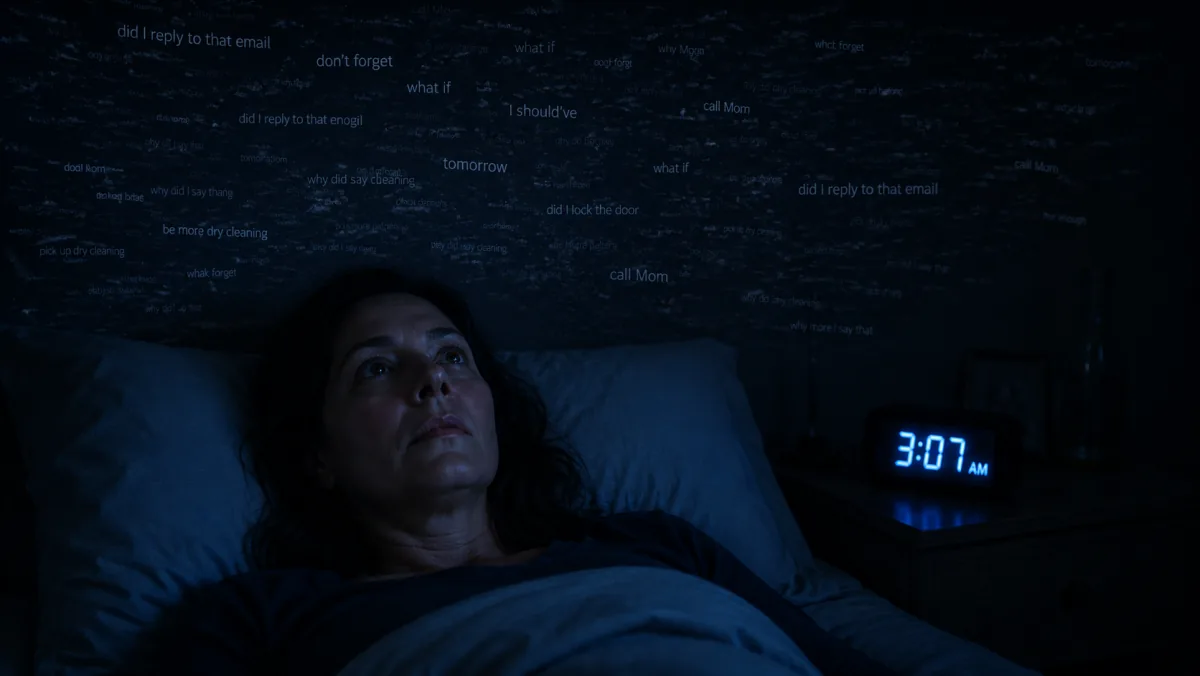
You Wake at 3am With Your Mind Already Running, and You've Started Calling It "Just How I Sleep Now"
You fall asleep fine. It's 3am that finds you, eyes open, tomorrow's unfinished list already scrolling, a hum of dread before anything has even happened. Most women file this under bad sleep, hormones, or age. But waking in the small hours with a racing mind is one of the clearest signs of a nervous system that's been running in high-alert so long it no longer knows how to fully power down at night. It isn't that you can't sleep. It's that some part of you is still on guard. The signal points to nervous-system overload, and the first soothe step isn't another sleep app. It's gently teaching your body that it's finally allowed to stop bracing.
Once you can name what's actually happening, everything changes. The 3am isn't a sleep problem to fix. It's a signal to read. And signals have answers.
02
You Snap Over Something Tiny, and the Size of Your Reaction Surprises Even You
A small mess. A repeated question. Something you'd normally shrug off. Instead, a hot flare of irritation rises out of nowhere, far bigger than the moment deserves. Afterwards you feel ashamed and quietly add "short-tempered" to the list of things that are apparently wrong with you. But a reaction that's wildly out of proportion to its trigger is rarely about the trigger. It's the sign of an emotional system already carrying more than it can hold, with no slack left for one more demand. This is emotional overload, and the snapping is the overflow, not a character flaw. Naming it that way is what stops the shame spiral that usually follows.
There's a reason your patience has a shorter fuse than it used to, and it has nothing to do with who you are. It has everything to do with how much you've been carrying. The moment you can see the overload clearly, the shame lifts. And that's where relief actually starts.
03
You Finally Get a Free Hour, and It Feels Like Pressure Instead of Relief
The rare empty hour arrives, and instead of relief there's a strange restlessness, a guilt, a sense that you should be using it for something. You can't quite let yourself sink in. Most women call this "being bad at relaxing" and judge themselves for it. The truth is gentler: when your system has been in go-mode long enough, stillness can register as a threat rather than a reward, the body doesn't yet trust the quiet. This is a sign your nervous system has lost its felt sense of safe rest. The answer isn't to relax harder. It's to make rest feel safe again, in very small, very forgivable doses.
The morning routine most women are following is actually making their stress worse by 9am. The restlessness you feel when you sit down isn't a character flaw. It's a nervous system that's forgotten what safe feels like. That can be relearned. The guide shows you how.
04
You Sit Down to Rest and End Up Staring at Your Phone, Too Drained to Enjoy It
You finally stop, but you don't read the book, take the bath, or do the thing you've been craving. You scroll. Blankly. Not because you're lazy or addicted, but because you're so depleted that even pleasure now requires energy you don't have. This is one of the most misread signs of all: women see a willpower problem where there's actually a fuel problem. Staring at your phone in your one free moment is freeze, not choice. It points to deep depletion, and the answer is never more discipline. It's recovery designed for someone who genuinely has nothing left to give.
Most women over 40 are walking around at a 7 or 8 on the stress scale and genuinely believe they're at a 3. The blank scrolling isn't laziness. It's your system showing you exactly how depleted you really are. Once you can see the real number, you stop blaming yourself and start recovering.
05
Noise, Music, and Small Sounds Have Started to Feel Like Too Much
The radio that used to be company now grates. You skip song after song because none feel right. The children's noise, the open-plan office, the TV in the next room, suddenly all of it feels like sandpaper. It's easy to dismiss this as "being in a mood." But when sound, light, and touch start to feel overwhelming, it's a clear marker of sensory overload: a system taking in more input than it can process. It isn't that you've become difficult or oversensitive. It's that you're full. Recognising it as overload, rather than intolerance, is what lets you start turning the volume down on purpose, without the guilt.
There's a reason you've been feeling 'off' for months, and it has nothing to do with getting older. Sensory overload is one of the 300 hidden signals most women mistake for personality changes. Once you can name it correctly, you stop calling yourself difficult and start giving yourself what you actually need.
If You Recognised Even One
The full guide names all 300 signs, and exactly what to do about each.
You Feel Guilty Every Time You Sit Down Without a Task to Justify It
You can't simply be still. To rest, you first have to earn it, finish the list, clear the sink, answer the message, and even then the guilt follows you to the sofa. You may never have questioned this; you may assume everyone feels it. They don't. Guilt around rest is one of the most telling signs in high-functioning women, because it reveals an identity built entirely around usefulness, where stopping feels like failing. This is rest-guilt, and it's quietly exhausting on its own. The soothe step here isn't another productivity hack. It's permission, the genuinely radical idea that you're allowed to rest without first working yourself to the ground.
Normal and healthy aren't always the same thing. Most women don't realise rest-guilt is a stress signal because it feels so familiar. But the moment you stop treating it as a personal flaw and start seeing it as a message, the hold it has starts to loosen. That recognition alone is a relief step.
07
Words Go Missing, You Reread the Same Line, and Your Thoughts Feel Like They're Moving Through Mud
Mid-sentence, the word you want simply isn't there. You read the same paragraph three times. You walk into rooms and forget why. You've started writing everything down because you no longer trust yourself to hold it. Most women panic quietly here, wondering if it's early decline or "just getting older." But brain fog, word-finding trouble, and that thoughts-in-treacle feeling are classic signs of cognitive overload: a mind so loaded with background processing it has little left for the task in front of you. Your intelligence hasn't gone anywhere. It's buried under the load. And it comes back as the load comes down.
Perhaps the most reassuring thing: this doesn't mean you've become less intelligent. It doesn't mean you're losing yourself. It often means your mind has been carrying too much for too long. When you understand where it's coming from, the fear begins to give way to clarity. And it comes back as the load comes down.
08
You Snap at the People You Love Most, and the Guilt Afterwards Is Worse Than the Moment
The short tone with your child. The sigh at your partner. Patience that used to come easily, now in permanently short supply with exactly the people you'd never want to hurt. Then the guilt lands, heavy and certain: I'm becoming someone I don't want to be. This is perhaps the most painful sign of all, because it touches what matters most. But impatience with loved ones is very often the clearest evidence of depletion, not of who you really are. You're not becoming a worse mother, partner, or friend. You're running on empty, and the people closest to you are simply standing nearest when the tank hits zero.
The version of you that feels patient, warm and connected is still there. She's simply buried beneath exhaustion and a system that's been running on empty for far too long. The guilt you feel after snapping is the signal, not the sentence. And it points directly to what needs to come down before the patience can come back.
09
The Things You Used to Love Have Gone Quiet, and You've Stopped Expecting to Enjoy Them
The hobby, the music, the show, the meal out, things that used to light you up now register as flat. You go through the motions, but the feeling doesn't come. You've started calling it "adulting" and moved on. But emotional flatness, a numbness where pleasure used to live, isn't a personality change, and it isn't simply age. It's one of the ways a stretched system protects itself: when there's no capacity left, feeling itself gets turned down. This is emotional numbing, and it frightens women more than almost anything, because it feels like losing themselves. The colour does come back. But first the load has to lift.
Emotional numbness is often what happens when a system has spent too long in survival mode. Not a personality change, not who you've become. The woman you remember hasn't disappeared. She's waiting underneath the load. The colour does come back. But first you need the map.
10
The Quiet Thought You Haven't Said Out Loud: "I Don't Recognise Myself Anymore"
Underneath all the others sits this one, the sign most women never speak, because saying it makes it real. You look at yourself and can't quite find the person you used to be: the patient one, the warm one, the one who felt things and enjoyed things and had room inside for other people. In your lowest moments you wonder whether she's gone for good. This is the master signal, the one beneath the racing mind and the snapping and the flatness. It is not proof that you've changed forever. It's proof of how long you've been carrying too much, with no one to help you read the signs. She isn't gone. She's buried under a stack of signals nobody ever taught you to see.
Maybe you're not broken. Maybe you've simply been carrying more than anyone ever taught you to recognise. Once you can finally see the signals clearly, a different possibility emerges. She isn't gone. She doesn't feel so far away.
If you recognised even three of these, you're not broken, and you're certainly not lazy. You're carrying an Invisible Stress Stack that's grown so familiar you stopped feeling its weight. The full guide names all 300 signs, and more importantly, what to do about each one before burnout takes more than it already has.
"This book helped me recognise stress in ways I'd never considered, with warmth, clarity, and practical support. Each page feels like a quiet nudge back to myself."
Jannine Isaacs Verified
Get The Full Guide NowShow Me All 300 Signs →£27 introductory price · Instant access · 365‑day guarantee
What's Actually Inside, and Why It Feels Different From Everything You've Tried
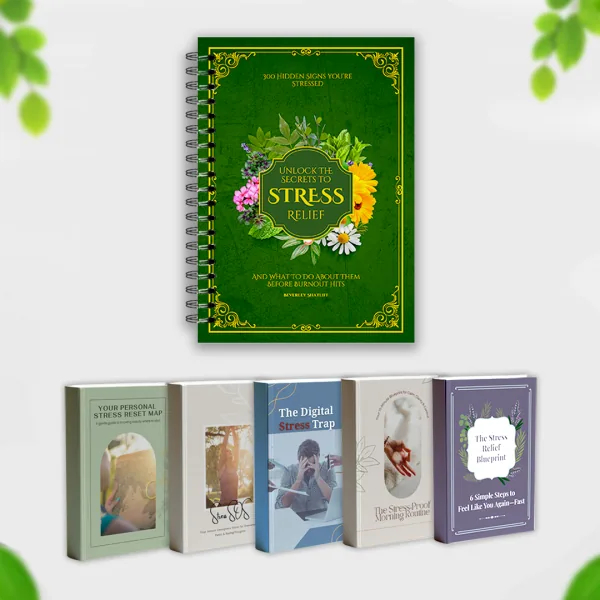
Unlock The Secrets To Stress Relief: 300 Hidden Signs You're Stressed And What To Do About Them Before Burnout Hits.
Written by Beverley Shatliff after 25 years in holistic health, this is not a general wellbeing book. It was built for the woman who's still functioning, still managing, and still quietly asking whether what she feels is "bad enough" to deserve attention. It doesn't ask you to meditate twice a day or overhaul your mornings. It asks only that you start reading what your body has been telling you all along.
The guide is organised around five categories of stress, because stress doesn't stay in one place. It spreads:
Mental: racing thoughts, brain fog, forgetting words, a mind that never stops but can't think clearly.
Emotional: irritability, flatness, numbness, snapping over small things, guilt when resting.
Behavioural: avoidance, scrolling instead of resting, skipping texts, the same meals on repeat.
Spiritual & Social: disconnection from purpose, withdrawing from people who matter, a hollowness hard to name.
The Signal to Soothe Method
1. Spot the signal. Recognise the hidden sign for what it is: not a flaw, a signal. 2. Name the overload. Understand which category it points to, so you treat the source, not the surface. 3. Soothe the system. Apply one small, appropriate relief step, without adding another overwhelming task to a life that's already full.
"We hear the word 'stress' all the time, yet it's such an umbrella term. Beverley breaks it down into 300 signs, allowing you to take action once you notice the first signs. I loved the simple layout, a clear description, a practical solution, and a calming affirmation. A great book to have to hand!"
Helen Shah Verified
Today's Introductory Price
Unlock The Secrets To Stress Relief (core guide)£97
Your Personal Stress Reset Map (Bonus 1)£19 FREE
Stress SOS, Emergency Reset (Bonus 2)£15 FREE
The Digital Stress Trap (Bonus 3)£15 FREE
Stress-Proof Morning Routine (Bonus 4)£17 FREE
The Stress Relief Blueprint (Bonus 5)£17 FREE
Total bundle value£180
Your Price Today
£27was £97
A single session with a stress coach typically costs between £60 and £90. This is the distilled version of 25 years of that work, for £27.
Get Instant Access For £27 →Instant digital download · All 5 bonuses included · 365‑day guaranteeThe price will return to £97. But that isn't the real cost of waiting. The real cost is another month of 3am wake-ups, another month of snapping at people you love, another month of carrying signals you could already be reading.
A Taste of What's Inside
Real signs, named plainly. Each paired with what it's telling you and one small thing to do about it.
Sign 257 - Sensitivity to Sound
You've started keeping the radio off in the car.
What it's telling you
Sensory overload. When your system is already processing more input than it can handle, even background sound becomes one demand too many. The silence isn't a new preference, it's your nervous system asking for less.
Your soothe step
Don't force the noise back on to "feel normal." For one week, let the quiet be allowed. Notice that choosing less input on purpose feels different from avoiding life, it feels like relief. That difference is the signal you're learning to read.
No jargon. No lectures. No 90-minute routines. Just the ability to finally read your own stress, and respond to it early, specifically, and without shame. And that's barely the beginning of the 300.
The Bonuses That Make This a Total Reset System
All five included free with today's introductory order.
Bonus 1
Your Personal Stress Reset Map
Identify which type of stress is most dominant for you right now, so you know exactly where to start instead of facing 300 signs without direction.
Bonus 2
Stress SOS, Your Emergency Reset for Overwhelm
A short, practical toolkit for the can't-think, everything-is-too-much moments, when you need help now, not later.
Bonus 3
The Digital Stress Trap
How always-on connectivity quietly amplifies every other stress signal, and what to do about it without deleting your whole digital life.
Bonus 4
The Stress-Proof Morning Routine
Not a 5am ritual. A genuinely realistic, low-pressure framework that sets your nervous system up for the day instead of throwing it straight into reactive mode.
Bonus 5
The Stress Relief Blueprint
The distilled version. The six most impactful steps, in the right order, for when you have twenty minutes and just want to begin.
Read the guide. Work through the signs that apply to you. If you don't feel it's helped you understand your stress patterns more clearly, email us any time within 365 days for a full refund. No questions asked. The risk is entirely ours. The only thing you have to lose is the confusion.
I already know I'm stressed. What will a guide tell me I don't know?
Knowing you're stressed and being able to see it clearly are two different things. This names the specific signs in your body, behaviour, and relationships you've been filing under personal failure for years. That shift, from "I'm bad at coping" to "I'm reading the signs now", is what actually changes something.
I don't have energy to read something long or start another routine.
Then it's built for you. You don't read it front to back. You turn to the area that feels most urgent, find the signs that match, and pick one small thing to do. You can start with a single sign. The whole philosophy assumes you're already exhausted.
My stress is caused by real things, my job, my children. A guide won't fix that.
True, and no honest product would claim to. What it removes is the second battle: the self-blame, the misread symptoms, the unrecognised overload stacked on top of the real pressure. Most women are fighting on two fronts. Removing the inner one changes everything.
Is £27 worth it when I've spent money on things that didn't help?
If it doesn't help, you're refunded for a full 365 days. The risk is ours. Readers say this one's different because it gives recognition first, language second, and a small action third. Most products skip straight to the action, which is why they fail women who don't yet know they're in step one.
Is the holistic and herbal side actually evidence-based, or is this wellness fluff?
The herbal remedies and holistic techniques in here come from 25 years of working with real women and centuries of traditional herbalism studied long before "wellness" became a marketing word. Each one is matched to a specific signal, not offered as generic advice. You're not buying a vision board. You're buying a holistic specialist's working notes, distilled into something you can actually use the same day.
What if my partner thinks this is woo-woo?
Fair question. Two things help. First, the guide is structured around signals and patterns, not crystals and chakras. Anyone who reads a page can see it for what it is: a practical map of what's happening in your body, with specific small steps. Second, you don't need them to believe in it for it to work for you. You only need them to leave you the ten minutes it takes to read it. Most partners come round once they notice you snapping less and sleeping better.
I'm a bit scared this will just confirm how bad things are.
That fear is completely understandable, and it's worth saying clearly: this isn't a diagnosis, and it isn't designed to frighten you. The opposite, really. Most women find that naming what's been happening is what lowers the fear, because the not-knowing, the quiet sense that something's wrong with you, is heavier than the truth. The truth is usually: you've been carrying too much, for too long, with no one to help you see it. That's not a verdict. It's a starting point.
From recent verified buyersReviews shared on our site and on social
Rachel Jones Verified
"Absolutely love this book. It's a practical manual for identifying when you're stressed and a roadmap for what to do to care for yourself. I love the short, clear snippets combined with affirmations to self-regulate, and all the practical, simple recipes, remedies and teas. What an amazing achievement."
♡ LikedReply5d
Lorraine Keeling Holistic Therapist
"As a holistic therapist, I found this book to be an enlightening and compassionate guide. Each entry is a mini-lesson in mindfulness and self-care, offering clear explanations, practical solutions, and soothing affirmations. A gentle guide back to oneself, a valuable resource for anyone on a journey of self-discovery and healing."
♡ LikedReply1w
Hollie Blakemore Verified
"I genuinely found this so helpful. The layout makes it incredibly easy to use, the abbreviated solutions in the clear boxes are perfect when you need quick answers. The home remedies are a brilliant bonus, and the size is perfect for my handbag so I can dip into it whenever I need a moment of calm. Highly recommend it!"
♡ LikedReply1w
Gabrielle O'Hare Verified
"Fabulous book that really opened my eyes about the signs and stages of stress. Lovely concept with lots of easy-to-dip-into tips. All women I know need this book. Highly recommended."
♡ LikedReply2w
Jannine Isaacs Verified
"This book helped me recognise stress in ways I'd never considered, with warmth, clarity, and practical support. Each page feels like a quiet nudge back to myself."
♡ LikedReply2w
Who This Is For
This is for you if you're still functioning on the outside but quietly running on empty. If you wake at 3am with a racing mind, snap at people you love, and feel guilty the moment you sit down. If you've tried meditation, baths, and routines and none of them stuck. If you suspect there's more going on than perimenopause or hormones, and you want a way to read your own body again.
Who This Isn't For
It probably isn't for you if you want a clinical diagnosis. If you're after a quick fix or a five-minute hack. If you need someone else to do the noticing for you. If you'd rather keep calling it "just how I am" than look at what's actually happening. None of those are wrong, they're just not what this is.
One Last Thing, For the Woman Who's Still Not Sure She Deserves This
There's a particular woman who will read every line on this page, recognise herself completely, feel the relief of being understood, and then not act. Not because she doubts it would help, but because some quiet part of her believes she has to be worse off before help is justified. That thought, "I'm not burned out enough to deserve this," is itself one of the 300 signs.
You don't need to reach the bottom to begin climbing back. You don't need to snap one more time, lose one more evening to 3am, or stare one more time at someone you love wondering where your patience went. Your body has been whispering. The signs have been there all along. You just needed someone to help you read them.











"Absolutely love this book. It's a practical manual for identifying when you're stressed and a roadmap for what to do to care for yourself. I love the short, clear snippets combined with affirmations to self-regulate, and all the practical, simple recipes, remedies and teas. What an amazing achievement."
"As a holistic therapist, I found this book to be an enlightening and compassionate guide. Each entry is a mini-lesson in mindfulness and self-care, offering clear explanations, practical solutions, and soothing affirmations. A gentle guide back to oneself, a valuable resource for anyone on a journey of self-discovery and healing."
"I genuinely found this so helpful. The layout makes it incredibly easy to use, the abbreviated solutions in the clear boxes are perfect when you need quick answers. The home remedies are a brilliant bonus, and the size is perfect for my handbag so I can dip into it whenever I need a moment of calm. Highly recommend it!"
"Fabulous book that really opened my eyes about the signs and stages of stress. Lovely concept with lots of easy-to-dip-into tips. All women I know need this book. Highly recommended."
"This book helped me recognise stress in ways I'd never considered, with warmth, clarity, and practical support. Each page feels like a quiet nudge back to myself."